الموسوعة
Encyclopedia of Maritime Governance and Regulation
A specialist reference for understanding international regulation, designing port governance and turning knowledge into executive decisions, with documented articles, management checklists and traceable primary sources.
- 40 specialist articles
- 10 subject areas
- 11 visual frameworks
Encyclopedia articles are currently available in English and Persian.
Reading paths
Ten subject areas, from rule to implementation
Each area is an ordered reading path that starts with the basics and ends with executive decisions.
- 01
IMO Regulation and Compliance
How IMO rules are made, what makes them binding and how States prove they implement them.
- 02
Seafarers and the Human Element
STCW certification, training oversight, MLC 2006, fatigue and the people who make rules work.
- 03
Port Governance and Institutional Reform
Port governance models, performance indicators, concession oversight and renegotiation.
- 04
Contracts and Risk Management
Tender design, scope of work, choice of legal instrument and risk allocation.
- 05
Negotiation and International Cooperation
Preparing delegations and turning memoranda of understanding into measurable cooperation.
- 06
التحول الرقمي البحري
The maritime single window, data governance and cyber risk in ports.
- 07
Decarbonisation and Climate Regulation
The IMO strategy, the EU ETS and FuelEU Maritime, and deciding under regulatory uncertainty.
- 08
Investment and PPP
Public-private partnerships in ports, bankability and public value.
- 09
Independent Expertise and Dispute Prevention
Independent expert reports and preventing maritime disputes from escalating.
- 10
Training and Competence Development
Quality assurance in executive training and learning that leads to real decisions.
Library
All encyclopedia articles
40 مقالات
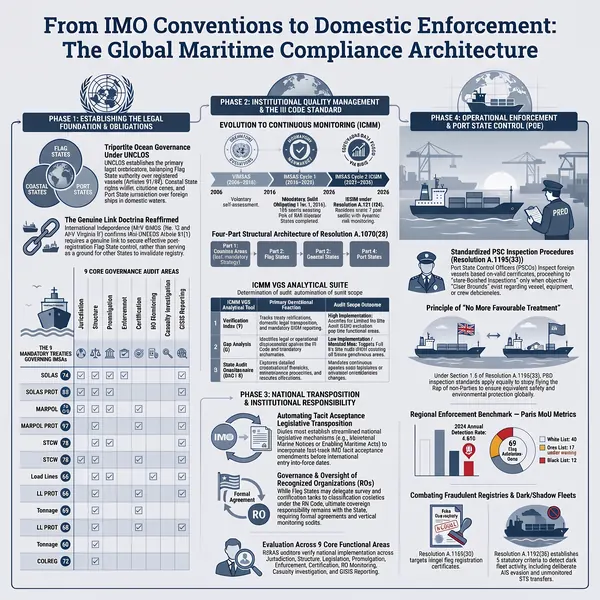
From accession to results: how the III Code becomes a roadmap for implementing maritime obligations
The III Code is more than audit preparation. It is a model for assigning responsibility, producing evidence that the law is applied and improving maritime governance for the long term.
Choosing a port governance model: from asset ownership to accountability for performance
The four classic port management models are only a starting point. The quality of regulation, contracts and accountability decides whether reform succeeds.
Preparing for the comprehensive STCW review: fixing the quality system before the rules change
The STCW review does not yet make the proposed requirements binding, but it is an opportunity to improve training, independent evaluation and certification.
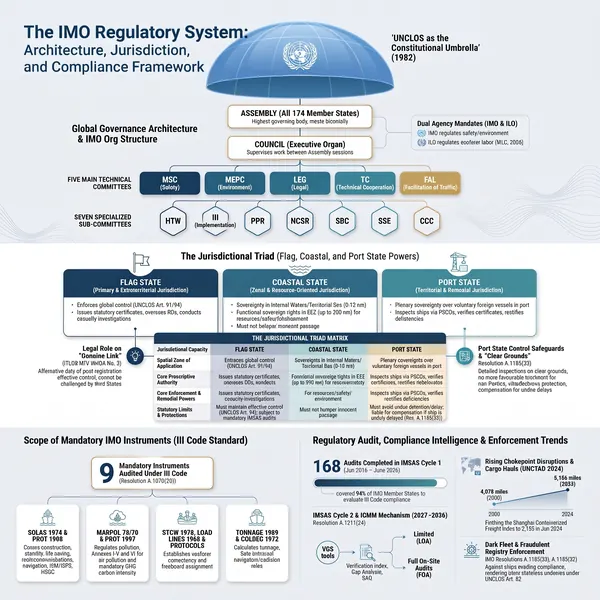
Conventions, codes, resolutions and circulars: how do IMO instruments differ in legal force?
A guide for decision-makers on telling which instruments are binding and avoiding costly mistakes when citing regulations.
How IMO decisions are made: from technical proposal to enforceable obligation
When does a committee proposal become an obligation, and how should a maritime organisation track the adoption process?
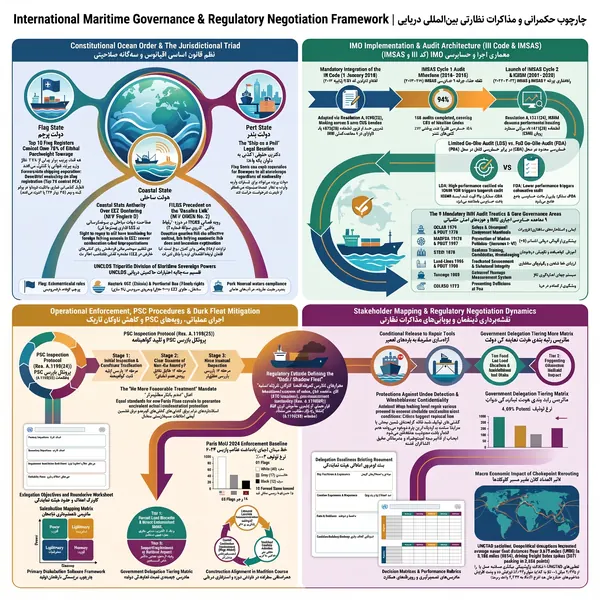
Maritime regulatory intelligence: an early warning system for managers
From monitoring IMO and ILO amendments to a one-page, decision-focused report for the board.
Preparing for IMSAS: the evidence that shows obligations are really implemented
Turn the Member State audit from a file-collection project into a permanent cycle of evidence, accountability and correction.
Port State control and flag State responsibility: two complementary layers of safety
The difference between the flag State's continuous oversight and the port State's case-by-case control, and the management consequences of a ship detention.
A port performance dashboard: which indicators really help decisions?
Combine berth productivity, waiting time, contract performance and quality of accountability in one balanced measurement model.
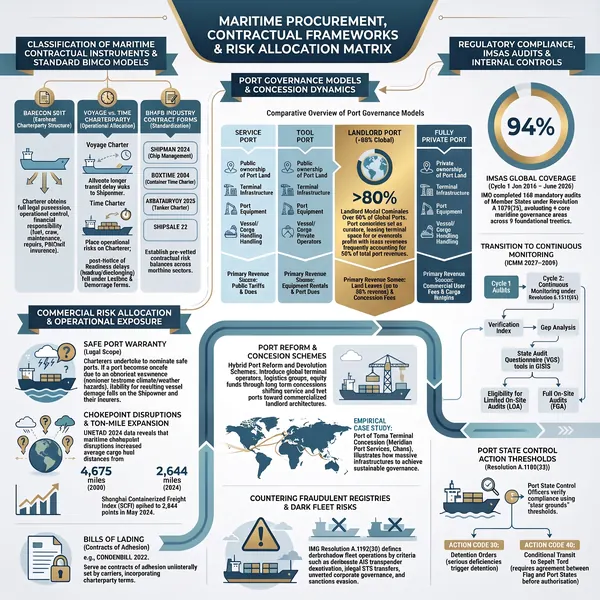
Overseeing port concession agreements: from investment commitments to service quality
A concession agreement without a monitoring system, transparent information and a corrective action mechanism is not an effective governance tool.
Investment and public-private partnership in ports: the test of institutional bankability
Before the financial model, assess how reliable the permits are, how risk is shared and whether the granting authority has the power to award.
Issuing and recognising STCW certificates: controlling authenticity, competence and quality
From the difference between a CoC and a CoP to the certificate verification system and quality control of issue at flag State level.
MLC 2006 and seafarers' welfare: from meeting the minimum to governing the human element
Seafarers' working conditions, repatriation and complaint procedures are part of a shipping company's operational and reputational risk.
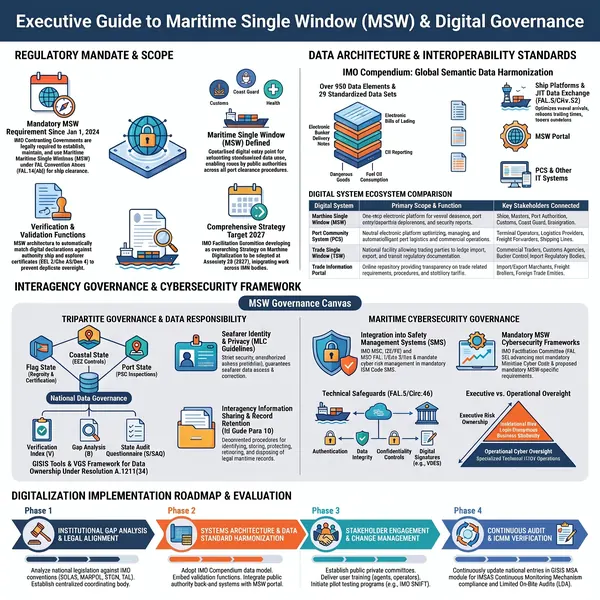
The maritime single window (MSW): from a FAL Convention requirement to implementation in port
A page of links to several systems is not enough; an MSW needs data governance and real exchange between agencies.
Data governance and cyber risk in ports: a responsibility beyond the IT department
A map of decision rights over data, service continuity and information and operational technology risk in a port.
Designing a maritime tender: from the scope of services to a risk allocation matrix
How to prepare RFP documents that are clear, can be evaluated and stand up to contractual disputes.
Maritime contract, memorandum of understanding or concession: choosing the right legal instrument
Before negotiating the text, the nature of the obligation, the signatory's authority and the desired means of enforcement must be clear.
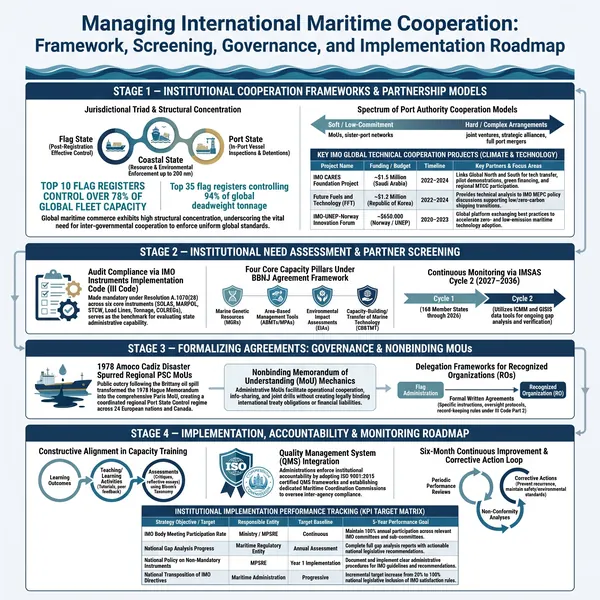
Preparing a maritime negotiating delegation: from a map of interests to the text of an agreement
A delegation briefing book, clear limits of authority and a system for documentation raise the quality of bilateral and multilateral negotiations.
From maritime MoU to measurable cooperation: how to keep an MoU from staying on paper
International cooperation must be tied to an action plan, an implementation owner, resources and an indicator of results.
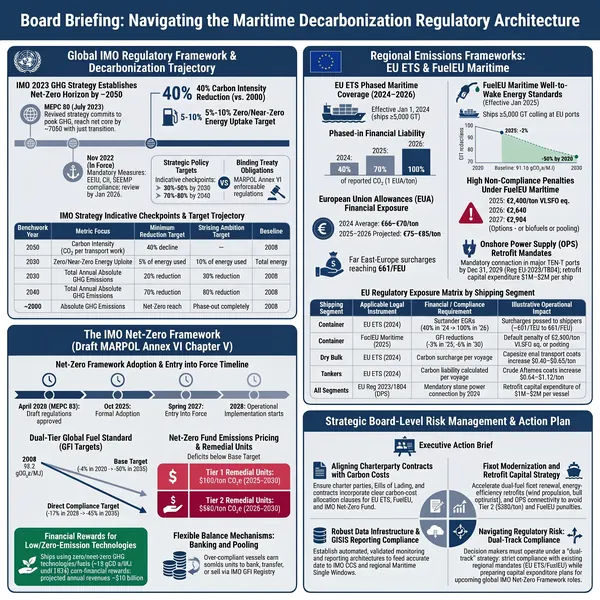
Maritime decarbonisation at IMO: separating the 2023 Strategy from the Net-Zero Framework
Managers should see the strategic targets, the existing MARPOL rules and the text of the proposed net-zero framework in three separate columns.
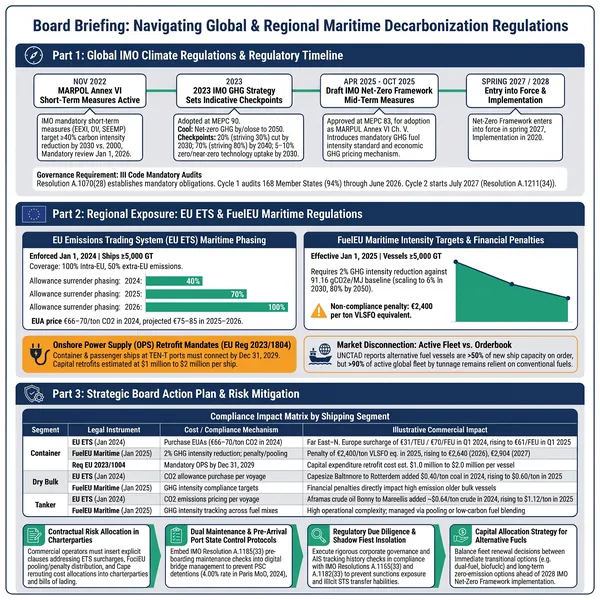
EU ETS and FuelEU Maritime: an exposure matrix for shipping companies
Two European regimes with different logic that affect voyage routing, emissions data, contracts and financial decisions.
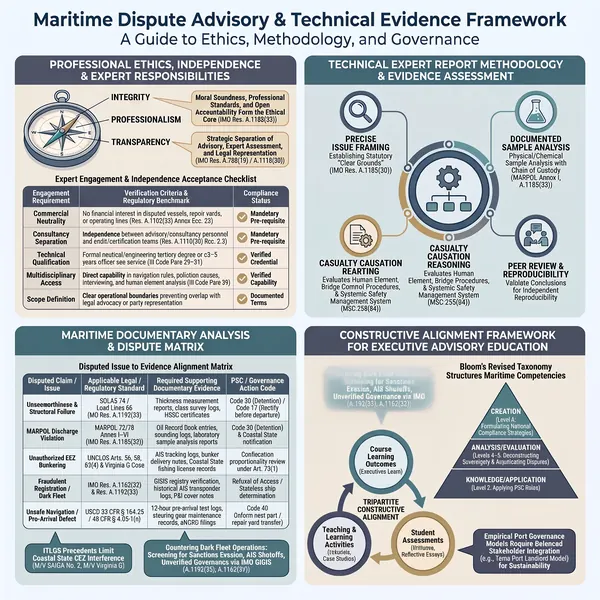
Independent expert reports in maritime disputes: from claims to evidence that can be checked
An expert must keep the lines between industry analysis, legal interpretation and expert evidence clear.
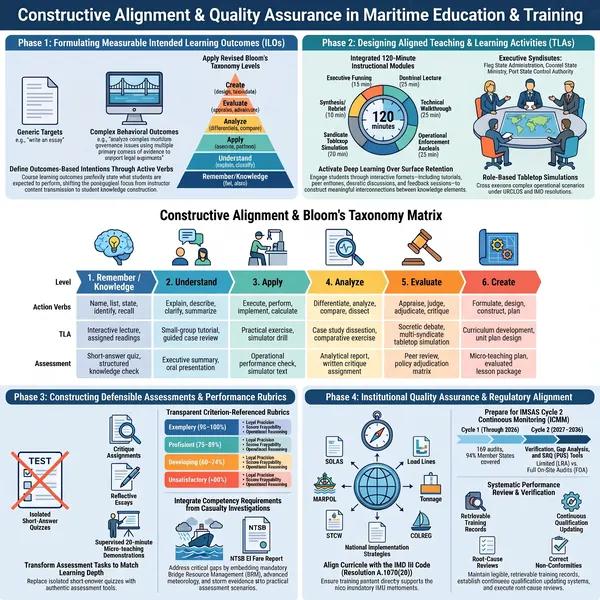
Quality assurance in maritime executive training: from syllabus to competence that can be assessed
Aligning learning goals, learning experience and assessment is what separates specialist courses from mere lectures.
Why accession to a maritime convention does not mean it is implemented successfully
Ratifying an international treaty is only the start of a legal obligation. A maritime convention works over time not through the diplomatic formalities of accession, but through coherent incorporation of its provisions into national law, a clear division of administrative tasks and mechanisms for monitoring and correction.
Delegating tasks to recognised organisations: where does the State's responsibility remain?
Delegating survey and statutory certification powers to recognised organisations (ROs) never removes or transfers the sovereign responsibility of the flag State. Under international law it is the basis of a binding, continuous and accountable oversight system.
How should managers handle IMO amendments before they enter into force?
Following IMO's public news is not enough to ensure an organisation complies. Effective management needs a regulatory intelligence process that carries amendments from early negotiation through applicability assessment, allocation of responsibility and readiness for implementation.
What do port State control findings reveal about management weaknesses?
Port State control (PSC) deficiencies and detentions should not be treated as isolated technical events. When they recur, they are reliable diagnostic signs of structural weakness in a company's safety management system, maintenance planning and shore-side oversight.
Where does a successful maritime tender begin? With a well-defined scope of work
The main cause of failed tenders, unrealistic pricing and exhausting claims in maritime projects lies not in evaluation or performance, but in a vague, incomplete and non-standard scope of work in the original documents.
Poor risk allocation: how a maritime contract turns into a dispute
Loading every operational, legal and unforeseen risk onto the other party is not good drafting. It is a reliable recipe for financial failure, a stalled project and a maritime contract that ends in exhausting litigation or arbitration.
Renegotiating a port contract: a necessary correction or a sign of weak governance?
Renegotiation of a long-term port contract is not in itself a policy failure. It sits on a sensitive line between legitimately restoring economic balance after unforeseen shocks and weakening competition while shifting a financial burden onto the public interest.
Recognising seafarers' certificates: why an administrative agreement is not enough
Signing an administrative undertaking between two maritime authorities to recognise certificates of competency is only a first step. Recognition under Regulation I/10 of the STCW Convention is effective and legally sound only with online verification of authenticity and continuous assessment of the issuing State's quality system.
Oversight of maritime training institutions: beyond checking documents and licences
Approving maritime training institutions does not end with an administrative review of syllabi and a check of the premises. Effective public oversight needs performance-based assessment of competence, audits of instructors' qualifications, validation of simulator scenarios and follow-up of the correction of non-conformities.
Seafarer fatigue: why safety management is incomplete without the human element
Formal compliance with hours of work and rest records does not protect a seafarer from loss of alertness. Sound safety management means linking the STCW and MLC 2006 standards with IMO's comprehensive fatigue guidelines and a just reporting culture in shipping companies.
What does a successful maritime negotiating delegation prepare before entering the room?
Success in bilateral negotiations or international maritime meetings is not decided in the plenary hall. It is the product of a structured process of setting the mandate, mapping interests, fixing red lines and building scenarios for positions before the meeting.
From signing an MoU to delivering cooperation: why do so many agreements produce nothing?
Signing a memorandum of understanding (MoU) is not the end of maritime cooperation. Without an organisational owner for each commitment, an assessment of the partner's capacity and an action plan with measurable indicators, most agreements remain ceremonial documents.
Why must maritime executive training lead to real organisational decisions?
The real value of training programmes for senior maritime managers is not measured by the number of slides, attendance hours or final certificates. Training is effective when it leads directly to better decision-making competence and to documents the organisation can actually use.
Port public-private partnerships: when does investment become public value?
Attracting private capital to ports is not in itself a sign of economic success. A public-private partnership (PPP) creates lasting public value when it rests on a transparent tender, balanced risk sharing, independent oversight of tariffs and measurable performance indicators.
Shipping decarbonisation: how should managers decide under regulatory uncertainty?
Managing the energy transition in shipping does not mean waiting passively for deadlines. Steering a fleet strategically means separating binding requirements from aspirational targets, building scenarios for alternative fuel pathways and taking no-regret actions now.
The maritime single window: why digitalisation needs governance before technology
A maritime single window is not delivered by buying software. Before any technology infrastructure, it needs a data governance architecture, re-engineered procedures between agencies and clear ownership of information among public authorities.
The independent expert in maritime disputes: how impartial analysis stops a dispute escalating
An independent expert's role in maritime disputes is not just writing a report for the court. An impartial review of the document chain, a precise definition of what each claim covers and verification of the technical facts are the most effective tools for early settlement and for preventing escalation.
No article matches this search.
Maritime governance and management frameworks
Eleven visual frameworks, each with an encyclopedia entry
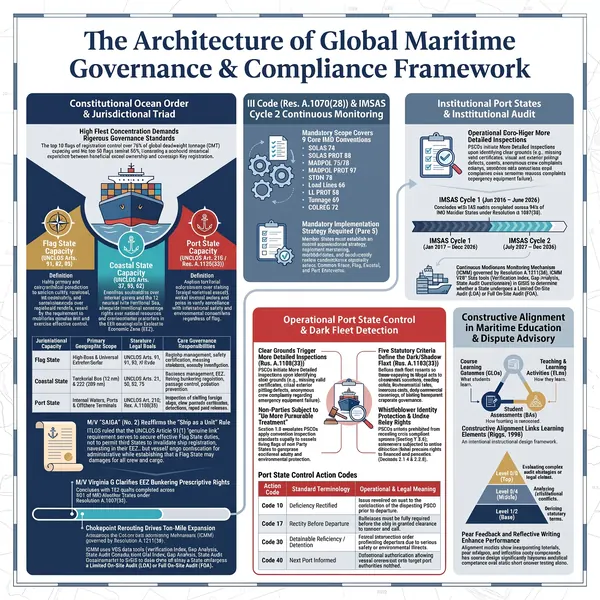
Every encyclopedia article uses one of the atlas images as its reference figure. The atlas presents all eleven images in learning order.
View the visual atlas- 01The Architecture of Global Maritime Governance and Compliance
- 02Maritime Governance, Regulation and Negotiation Framework
- 03The IMO Regulatory System
- 04From IMO Conventions to National Implementation and Compliance Oversight
- 05Maritime Single Window and Digital Port Governance
- 06Procurement, Contract Governance and Maritime Risk
- 07Expert Advisory and Prevention of Maritime Disputes
- 08International Maritime Cooperation: Framework and Roadmap
- 09The Global and Regional Architecture of Maritime Decarbonisation Regulation
- 10Management and Economic Implications of Decarbonisation Rules
- 11Quality Assurance and Competence Development in Maritime Education
حوار سرّي
اطلب استشارة
If a topic in this encyclopedia is on your organisation's agenda, let us discuss it.