Maritime governance is the product of a complex interplay between international law, regulatory institutions, State responsibility and the operating mechanisms of the shipping industry. In eleven parts, this visual atlas examines maritime governance from its legal foundations and rule-making system to digitalisation, risk management, international cooperation, the climate transition and quality assurance in training.
This atlas is independent educational and analytical content. It is not endorsed by, and does not imply any institutional affiliation with, the International Maritime Organization (IMO) or any other body. The images are educational summaries; for legal application always refer to the official, current text of the instruments.
Chapter 1
Who governs the oceans?
The story starts with the overall architecture of ocean governance, then moves to the institutions, jurisdictions and the international and national mechanisms that oversee compliance.
Imagen 01 de 11
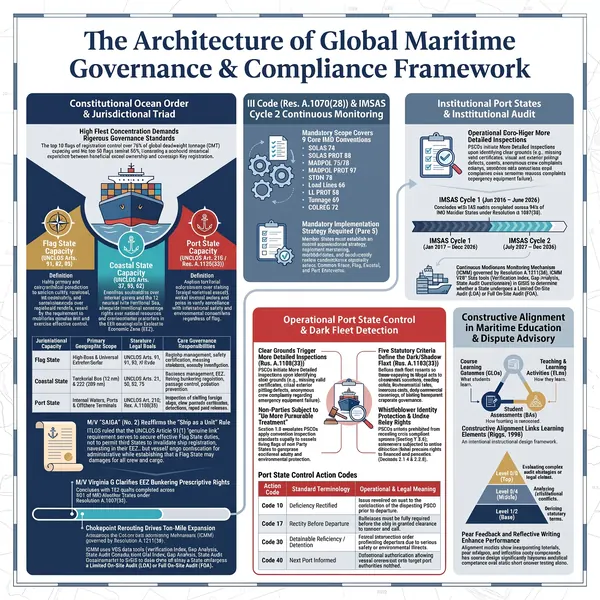
The Architecture of Global Maritime Governance and Compliance
Every ship sits at the meeting point of three legal authorities: the State whose flag it flies, the coastal State whose waters it crosses and the port State where it calls. This figure sets out that jurisdictional triad under the 1982 UN Convention on the Law of the Sea and shows how IMO audits and port State control check whether those responsibilities are actually carried out.
Figura 01The jurisdictional triad of flag, coastal and port States under UNCLOS, linked to the IMO audit scheme and port State control as the two main checks on compliance.
Three key points in this image
The flag State carries the primary responsibility: UNCLOS Article 94 requires it to exercise effective jurisdiction and control over its ships.
Coastal State rights grow weaker with distance: full sovereignty in the 12-mile territorial sea, functional rights in the 200-mile exclusive economic zone.
Port State control is the safety net that catches substandard ships when flag State oversight fails.
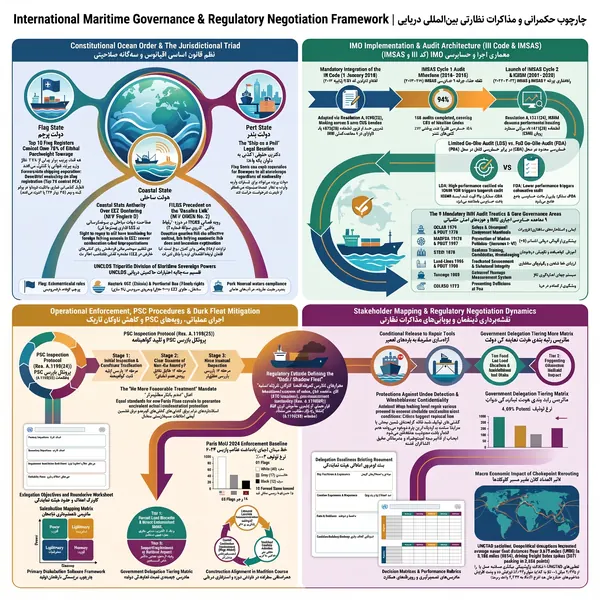
Maritime Governance, Regulation and Negotiation Framework
Rules on paper only matter once they are negotiated, adopted, implemented and enforced. This figure connects the foundations of the law of the sea with IMO's implementation and audit architecture, operational enforcement through port State control and the stakeholder dynamics that shape every regulatory negotiation.
Figura 02Four linked quadrants: the jurisdictional order of the oceans, IMO implementation and audit, port State control enforcement, and stakeholder mapping in regulatory negotiation.
Three key points in this image
Regulation is a cycle: negotiation, adoption, national implementation, enforcement and review.
Regional port State control agreements such as the Paris and Indian Ocean MoUs turn shared standards into coordinated inspections.
A negotiating position is stronger when it is built on a clear map of stakeholders, interests and implementation capacity.
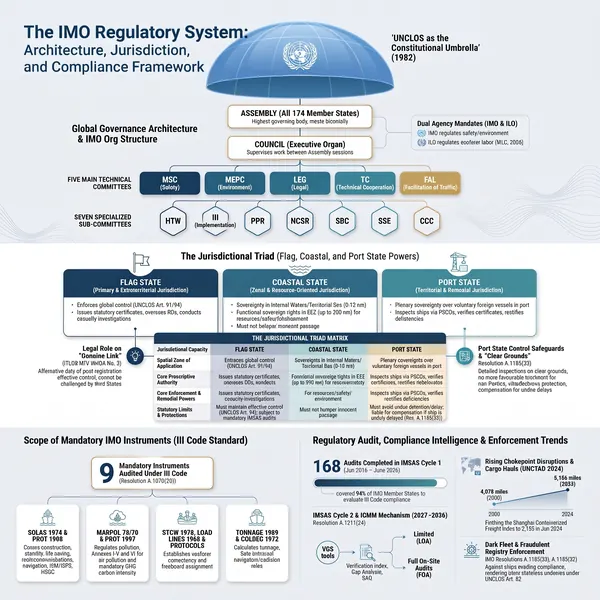
The International Maritime Organization is the UN specialised agency responsible for the safety and security of shipping and the prevention of pollution by ships. This figure shows how it is organised, from the Assembly and Council to its five committees and seven sub-committees, and which mandatory instruments form the core of its regulatory system.
Figura 03IMO's institutional structure under the UNCLOS umbrella, the jurisdictional triad matrix and the mandatory instruments covered by the III Code.
Three key points in this image
The Assembly of all Member States is the highest body; the 40-member Council acts as the executive organ between Assembly sessions.
Most technical work happens in the five committees (MSC, MEPC, LEG, TC and FAL) and seven sub-committees.
IMO adopts rules but does not enforce them; enforcement belongs to flag, coastal and port States.
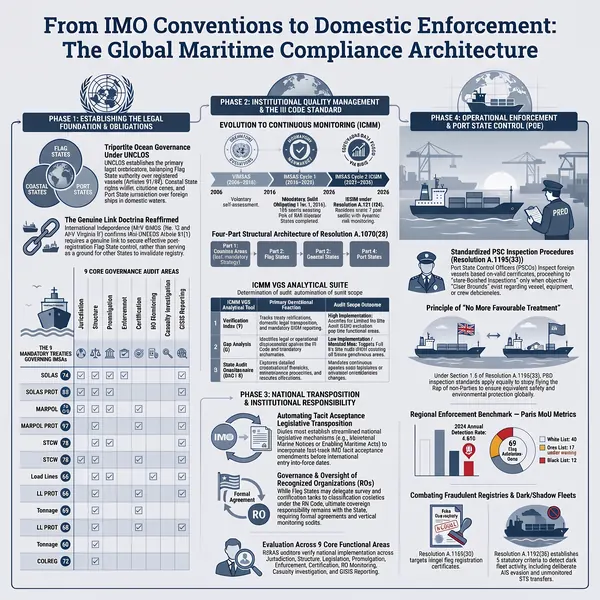
From IMO Conventions to National Implementation and Compliance Oversight
Ratifying a convention is a promise; implementing it is the work. This figure traces the chain that turns IMO instruments into national law, institutional responsibility, survey and certification, and finally into inspections and audits that test whether the system really works.
Figura 04Four phases of compliance: the legal foundation, quality management under the III Code, national transposition and oversight of recognised organisations, and operational enforcement through port State control.
Three key points in this image
The III Code (Resolution A.1070(28)) has been the audit standard for Member States since IMSAS became mandatory on 1 January 2016.
Delegating surveys to recognised organisations does not delegate responsibility; the flag State must oversee them.
Port State control applies the principle of no more favourable treatment, so ships of non-parties are inspected to the same standard.
This chapter moves from regulation to the practical questions faced by administrations, ports and companies.
Imagen 05 de 11
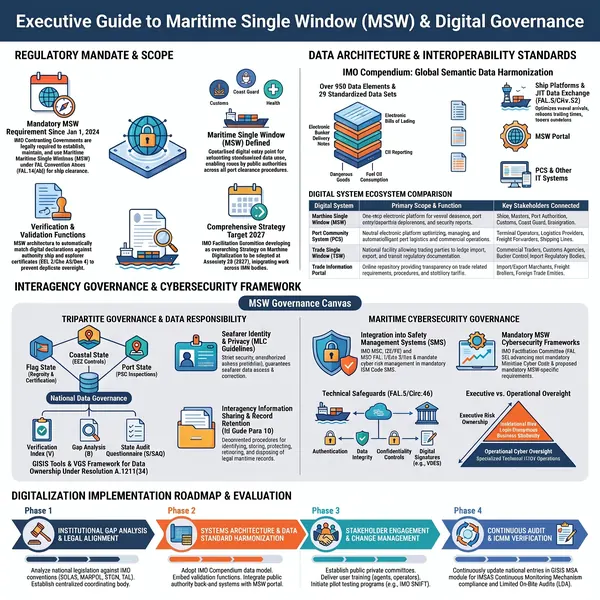
Maritime Single Window and Digital Port Governance
Since 1 January 2024, amendments to the FAL Convention have required public authorities to exchange ship clearance information electronically through a single window. This figure is an executive guide to what that means: the legal mandate, the data standards, the governance of data shared between agencies, cyber risk and a phased roadmap.
Figura 05The mandatory maritime single window, the IMO Compendium data model, inter-agency data governance and cyber security, and a four-phase digitalisation roadmap.
Three key points in this image
The single window is a governance project before it is an IT project: someone must own the data and the decisions.
The IMO Compendium on Facilitation and Electronic Business provides the shared data model that makes systems interoperable.
Cyber risk must be managed within the ship's safety management system, as required since 2021 under Resolution MSC.428(98).
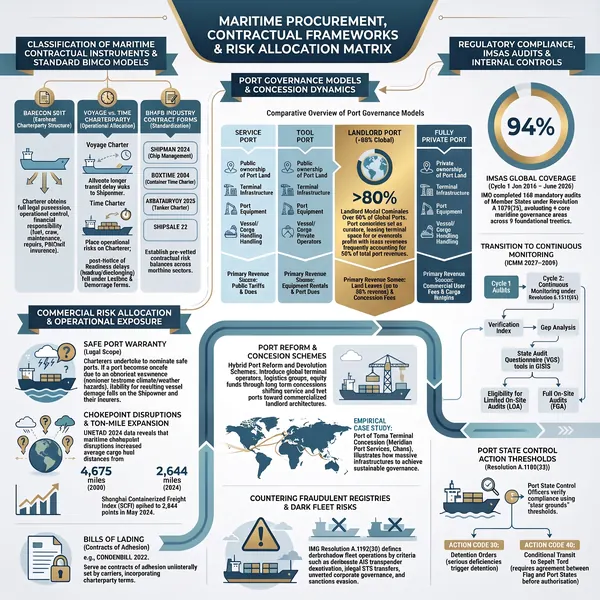
Procurement, Contract Governance and Maritime Risk
Who carries the risk when a port becomes unsafe, a voyage is delayed or a concessionaire underperforms? The answer is usually decided long before the problem appears, in the tender and the contract. This figure brings together standard contract forms, port governance and concession models, commercial risk allocation and the compliance checks that sit around them.
Figura 06Standard maritime contract forms, a comparison of port governance models, commercial risk allocation and the regulatory controls that frame procurement.
Three key points in this image
Standard forms such as BIMCO's are a starting point; the real risk sits in the amendments and rider clauses.
In the landlord port model, the authority keeps the land and regulation while private operators invest in and run terminals.
A concession is only as good as the performance obligations the authority can actually monitor and enforce.
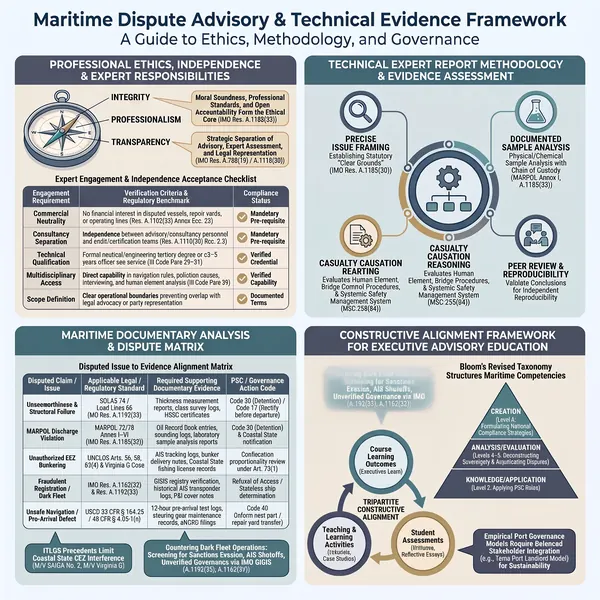
Expert Advisory and Prevention of Maritime Disputes
Many maritime disputes are decided by the quality of the technical evidence and the independence of the person who assesses it. This figure sets out the ethics of expert work, a method for building a technical opinion, a matrix linking disputed issues to the evidence that resolves them, and how the same discipline can be taught to executives.
Figura 07Professional ethics and independence, a technical evidence methodology, an issue-to-evidence dispute matrix and an executive education framework.
Three key points in this image
An expert's value depends on independence: advisory, expert assessment and legal advocacy are separate roles.
Good evidence is framed by a precise question, documented with a chain of custody and open to peer review.
Most disputes can be prevented earlier through clear contracts and records kept as if they will one day be examined.
How international cooperation moves from identifying a need and choosing a partner to an agreement, clear accountability, an implementation plan and performance monitoring. This chapter bridges domestic governance and the international engagement of maritime organisations.
Imagen 08 de 11
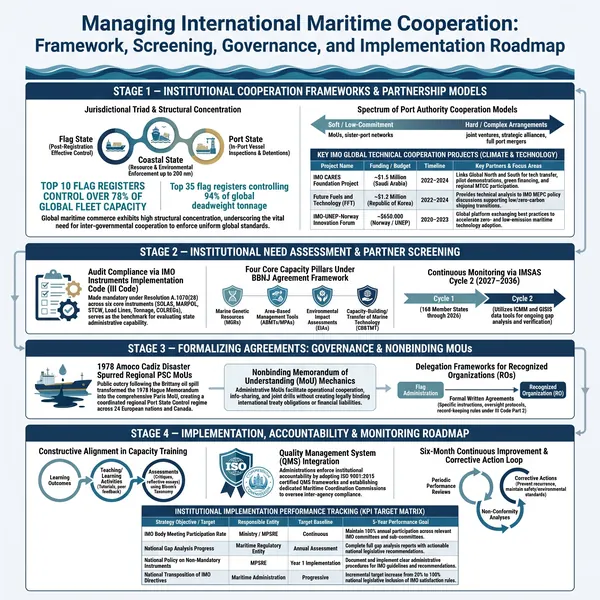
International Maritime Cooperation: Framework and Roadmap
Memoranda of understanding are easy to sign and hard to bring to life. This figure follows cooperation through four stages: choosing the right partnership model, assessing needs and screening partners, formalising the agreement, and implementing it with clear accountability, performance indicators and a cycle of review.
Figura 08A four-stage roadmap for international maritime cooperation, from partnership models and partner screening to formal agreements, accountability and performance tracking.
Three key points in this image
Cooperation models range from light-touch MoUs and sister-port arrangements to joint ventures and strategic alliances.
Regional port State control grew out of cooperation: the 1978 Amoco Cadiz disaster led to the Paris MoU in 1982.
An agreement without owners, budgets and indicators rarely survives the change of the people who signed it.
First the global and regional architecture of decarbonisation rules, then their financial, contractual and board-level implications. The two figures are complementary, not repetitive.
Imagen 09 de 11
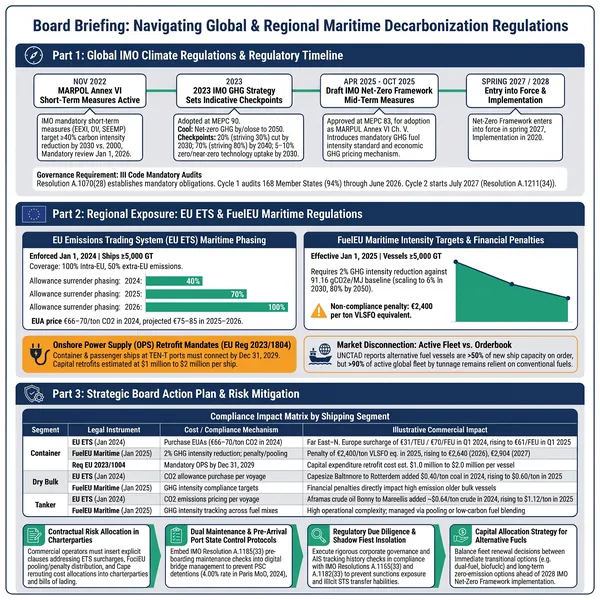
The Global and Regional Architecture of Maritime Decarbonisation Regulation
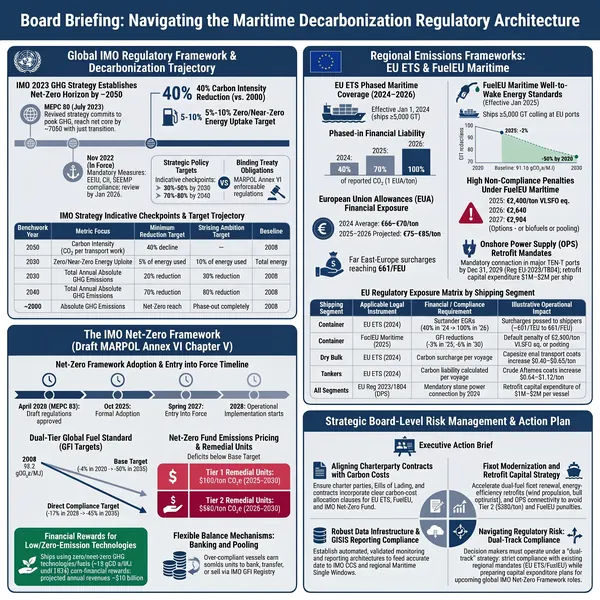
Shipping now faces two layers of climate rules at once: IMO measures that apply worldwide and regional European rules that already put a price on emissions. This board briefing separates measures in force from strategic targets and from drafts still under negotiation, so that decisions are based on the right legal status.
Figura 09The IMO 2023 GHG Strategy and short-term measures, the draft IMO Net-Zero Framework, and the EU ETS and FuelEU Maritime as regional regimes.
Three key points in this image
In force: EEXI and CII under MARPOL Annex VI since 2023, the EU ETS for shipping since 2024 and FuelEU Maritime since 2025.
Strategic target: the 2023 IMO Strategy aims for net-zero GHG emissions by or around 2050, with indicative checkpoints for 2030 and 2040.
Still under negotiation: the IMO Net-Zero Framework; its adoption, planned for October 2025, was postponed.
Management and Economic Implications of Decarbonisation Rules
Climate rules show up on the balance sheet: in surcharges, allowance purchases, penalties, retrofit budgets and new clauses in charter parties. This figure translates the regulatory timeline into its commercial consequences for container, dry bulk and tanker operators and sets out a board-level action plan.
Figura 10The regulatory timeline, EU ETS and FuelEU Maritime exposure, a compliance impact matrix by shipping segment, and a board action plan.
Three key points in this image
Under the EU ETS, shipping companies surrender allowances for 40% of 2024 emissions, 70% of 2025 emissions and 100% from 2026.
FuelEU Maritime requires a 2% cut in the GHG intensity of energy used on board from 2025, rising to 80% by 2050.
Charter parties need explicit clauses on who pays carbon costs and who controls the operational choices that drive them.
The story ends with people: competence-based training design, assessment of learning and quality assurance in maritime education.
Imagen 11 de 11
Quality Assurance and Competence Development in Maritime Education
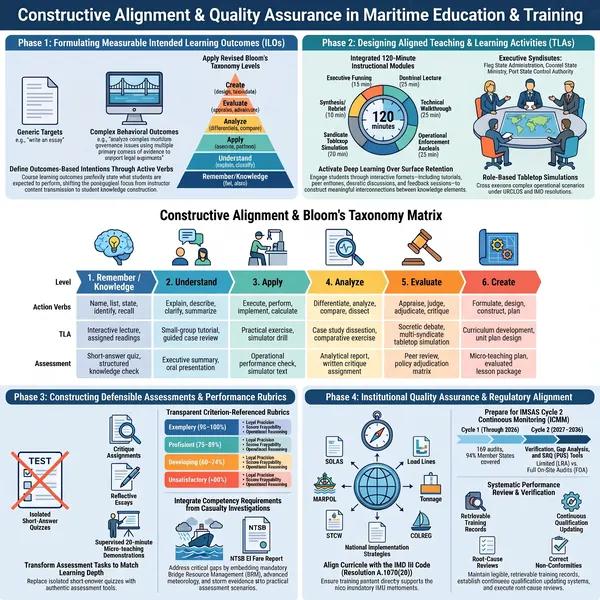
Every rule in this atlas is ultimately applied by people. This figure shows how maritime training can be designed around measurable competence: clear learning outcomes, teaching activities aligned with them, assessments that test what really matters, and an institutional quality system of the kind STCW requires.
Figura 11Four phases of constructive alignment: learning outcomes, aligned teaching activities, defensible assessment and institutional quality assurance.
Three key points in this image
Constructive alignment means outcomes, teaching activities and assessment all point at the same competence.
STCW Regulation I/8 requires training, assessment and certification to be monitored through a quality standards system.
Lessons from casualty investigations should feed directly into training content and assessment scenarios.
The atlas began with the jurisdiction of States, moved through institutions and the chain of implementation, reached data, contracts and disputes, examined cooperation and the climate transition and ended with education. Each link depends on the next.